|
I’m facing the retirement of two helpful physicians and knowing their replacements will be different in their approach to my illness. I am concerned about my care, especially if I have a relapse. I am grateful for all the ways these two physicians, known in my book as Dr. Three and Dr. Special, have helped me. I wish them a blessed retirement yet wish they could remain in the field for patients like me. A patient has to be assertive with, provide a timeline of illness events and tests to, and review records from physicians. I did all three with these two doctors after negative experiences with previous physicians. The patient/provider relationship is vital. There is a crucial need for physicians with knowledge of ME/CFS care, especially in light of the increase in cases of long COVID, or post-acute sequelae of COVID. If you’re a budding health care professional who wants to know more about ME/CFS, email me! If you want additional lessons learned from chronic illness, email me so that I send them your way! 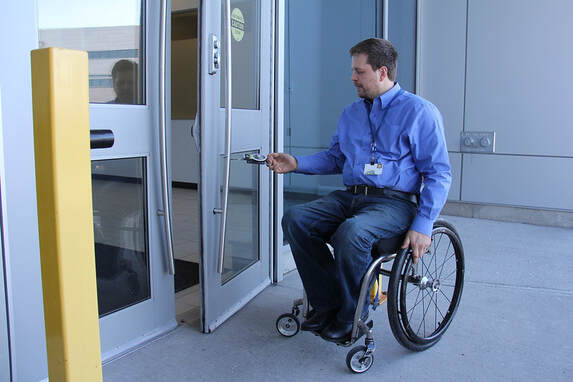 Photo: Province of British Columbia, Flickr Creative Commons Darla Nagel is a biomedical copy editor who has an invisible chronic illness. She wants to educate healthcare professionals and encourage patients. If you want to receive quarterly updates from her, email darla.nagel{a}gmail.com.
0 Comments
Can you bake on a dairy-free diet? Can you bake on a vegan diet? Yes and yes. Baked goods will still turn out without eggs and milk with a few substitutions. Here are three recipes I’ve made a few times: cranberry orange muffins, maple granola, and unbelievably vegan brownies. Cranberry Orange Muffins (Vegan) Makes 6 jumbo muffins. Adapted from Healthy Living Market.
Fill muffin tins 3/4 full and bake 23-25 minutes, until lightly browned on top and a toothpick comes out clean. Maple Granola (Vegan) Makes 8 cups. From Cookie and Kate.
American Girl Brownies (Yes, Vegan!) Yes, they’re soft in the middle! Makes a 13 x 9 pan. Adapted from American Girl.
Heat oven to 350. Whisk dry and wet ingredients separately, and then put the dry into the wet. Mix until just combined. Fold in chips. Pour into greased pan. Bake 34-36 minutes, until toothpick comes out clean. Why do I care about vegan baking? The reasons are both for health and the environment. Darla Nagel is a biomedical copy editor who has an invisible chronic illness. She wants to educate healthcare professionals and encourage patients. If you want to receive quarterly updates from her, email darla.nagel{a}gmail.com.
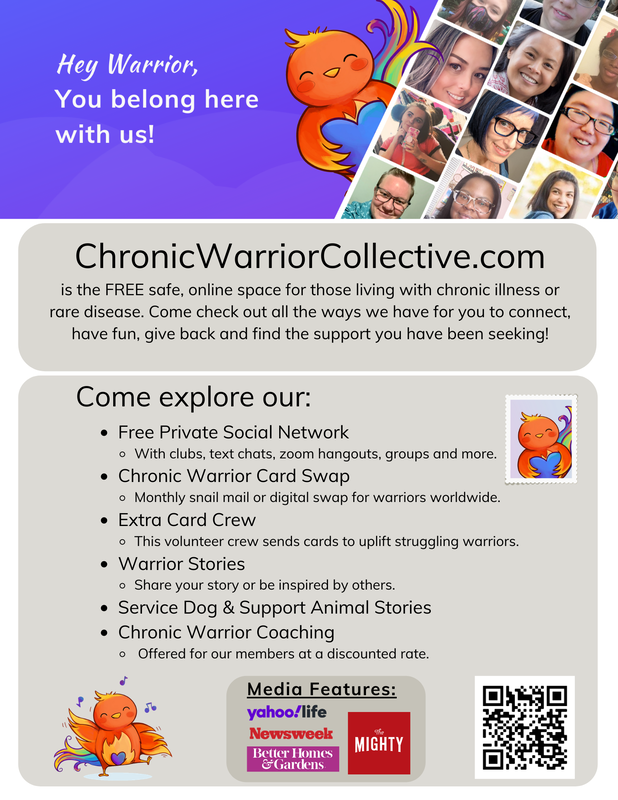 Since July I have been involved with the monthly Chronic Warrior Card Swap, in which people with chronic illnesses send one card to a recipient whose name and address are emailed to them. I enjoy making cards and brightening people's days, so this is a win-win for me. I always include an uplifting handwritten message in my cards. Then again, with these recipients, store-bought or printed-off cards are welcome as well. We have some understanding of the difficulties of daily life with illness. There are backup systems in place if you're not able to send a card in a given month.
This card swap is an easy way to help and meet other patients. It's not a chain letter system. I recommend joining. Get started by visiting ChronicWarriorCollective.com. I read an article that is part reflection on the cultural or philosophical purpose of illness memoirs and part review of What Doesn’t Kill You: A Life With Chronic Illness by Tessa Millerby. The article, “The Consolation of the Illness Memoir” by Anna Altman at The New Republic, caught my attention as the author of an illness memoir. Some intriguing quotes from the article:
The article’s author notes that she has chronic migraine. Even if illness memoirs so far have failed to revolutionize American health care and cultural treatment of people with chronic illnesses, I believe the books are well worth writing and reading, for the benefit of patients and those closest enough to them to truly listen. Have you written one? If so, let me know, and I'll read it! Darla Nagel is a biomedical copy editor who has an invisible chronic illness. She wants to educate healthcare professionals and encourage patients. If you want to receive quarterly updates from her, email darla.nagel{a}gmail.com.
As a person with Reynaud’s disease, I frequently try new ways of warming my fingers and toes. The two solutions I’ve tried this year are affordable (and available in pink, among other colors). I detest that they’re made in China instead of the USA but like their effectiveness enough to share them with others with cold fingers. AmazonBasics Desktop Space Heater This ceramic 6 x 6 x 3 space heater heats fast and well when aimed at my right hand. With only one button, it’s the easiest space heater to operate. It’s just heavy enough not to tip over and just loud enough to prompt me to turn it off during video calls. It cost me $26 on Amazon in January 2021. Beskar Hand Warmer I’ve managed to get this hand warmer to work for 7.5 hours (1 hour on medium and the rest on low) before recharge, which is longer than any electric hand warmer I’ve had. It’s easy to operate and a little larger than many other models. It cost me $25 on Amazon in January 2021. See a previous review of warming products here: https://www.darlanagel.com/blog/winter-warmer-product-reviews-for-feet-and-hands.   Darla Nagel is a biomedical copy editor who has an invisible chronic illness. She wants to educate healthcare professionals and encourage patients. If you want to receive quarterly updates from her, email darla.nagel{a}gmail.com.
Companies shouldn’t hesitate to hire qualified job candidates who have disabilities or chronic illnesses. These employees, overall, strive not to be burdens but instead to succeed. They are used to solving problems related to access, inclusion, and productivity, often in creative ways or with a team. See how many useful soft skills are mentioned in that sentence? Imagine the increased profits that could be realized through just one employee with these skills and work ethic. Disabled employees have plenty to offer, so offer them the job! Darla Nagel is a biomedical copy editor who has an invisible chronic illness. She wants to educate healthcare professionals and encourage patients. If you want to receive quarterly updates from her, email darla.nagel{a}gmail.com.
My first-ever blog post promoted person-first language when discussing people with disabilities, but some disabled people are advocating for identity-first language. We can embrace our disabilities as part of our identities in this way. It’s important to ask the people, when possible, the language they prefer to be used to describe them. If you’re curious about the reasons for the recent resurgence in identity-first language, here’s a summary of “Yes, You Can Call Me Disabled” by Anjali J. Forber-Platt, assistant professor at Vanderbilt University. Disability can be something to be proud of, but person-first language minimizes that point of pride. This pride could lead to positive changes for disabled people, such as improved access to resources and higher employment rates in more rewarding careers (thanks to reasonable accommodations). Forber-Platt says, “Intentional avoidance of the term disability sends the message that there’s something inherently negative or bad about having a disability. And disabled people are tired of non-disabled people telling us what they think is best for us.” Watch for further discussion of the benefits of hiring disabled employees in a future post. Darla Nagel is a biomedical copy editor who has an invisible chronic illness. She wants to educate healthcare professionals and encourage patients. If you want to receive quarterly updates from her, email darla.nagel{a}gmail.com.
Did you know a plant-based diet could decrease cancer risk by 13% and heart disease risk by 20%? Did you know animal agriculture causes even more greenhouse gasses than all forms of transportation combined? These are just two statistical findings reported in OMD: The Simple, Plant-Based Program by Suzy Cameron, wife of screenwriter and director James Cameron. While the bulk of this book reports the environmental and health benefits of eating more plant-based (aka vegan) meals, there are also personal anecdotes of the pleasures of eating this way and recipes. An alternative title for this book would be “No More Beef.” Some subtle promotion of the school the author founded is included but does not detract from the message of the book. Unlike other vegan lifestyle books I’ve read, this one doesn’t pressure you to become 100% vegan but strongly encourages changing just one meal per day. That is a very doable change, especially with Cameron’s product recommendations and suggested meal plan. Without knowing about this book, I began making my breakfasts and often my lunches vegan in February. I remain committed to eating one vegan meal per day. Although I haven’t noticed any obvious health improvements from this approach, my body is prone not to recognize what’s good for it (thanks to a case of ME/CFS). Plus, I trust the benefits will be seen later in life when I have fewer age-related conditions, such as heart disease. I also like not worrying as much about the maltreatment of animals that I’m encouraging by consuming their products or worrying as much about my impact on greenhouse gasses and water consumption. I heartily recommend this book to anyone interested in taking a small yet powerful step to improve their health and the environment.  Photo: Stefano Corso, Flickr Creative Commons Darla Nagel is a biomedical copy editor who has an invisible chronic illness. She wants to educate healthcare professionals and encourage patients. If you want to receive quarterly updates from her, email darla.nagel{a}gmail.com.
Did you know there is a scholarly field called disability studies, and did you know there is a disability justice movement? Both shed light on the experiences and societal needs of people with disabilities and seek the inclusion of a historically shunned group. To learn more about disability justice, read the works of activist Tobin Siebers and check out the Twitter hashtags #ThingsDisabledPeopleKnow and #DisabledAndCute. Quote from Siebers: “Disability marks the last frontier of unquestioned inferiority because the preference for able-bodiedness makes it extremely difficult to embrace disabled people and to recognize their unnecessary and violent exclusion from society” (Tobin Siebers, quoted in Amanda Leduc, Disfigured, page 209). Read my review of Disfigured below. Darla Nagel is a biomedical copy editor who has an invisible chronic illness. She wants to educate healthcare professionals and encourage patients. If you want to receive quarterly updates from her, email darla.nagel{a}gmail.com.
Amanda Leduc’s Disfigured: On Fairy Tales, Disability, and Making Space opens our eyes to how the portrayal of disabilities in fairy tales sets children up to shun disabled people, and she advocates for more accurate narratives of these excluded people. She weaves in her personal account of growing up with cerebral palsy, which keeps the book from becoming a scholarly work inaccessible to the majority of readers. You’ll never view the Disney princesses the same way again. This book was educational even for someone who has spent 10 years creating and sharing her own narrative of life with a disabling chronic illness that doesn’t have the classic fairytale happy ending, an ending which, according to Leduc, is not only unrealistic but also psychologically unhealthy. Great quotes from the book: “We exist in a world where happiness is synonymous with not being disabled—anything less than this comes across as undeserving, simply through virtue of not meeting the able-bodied ideal” (page 210). “This conceptualization of disability—at best merely a metaphor for psychological ills that can be overcome, at worse a punishment or judgment that can be reversed through magical or spiritual means, though only if one deserves it—does a disservice to the actual lived experience of what it means to occupy a different body in the world….denying the lived reality of what it means to be a disabled body in the world denies the possibility of growth on the disabled person’s terms” (page 216). 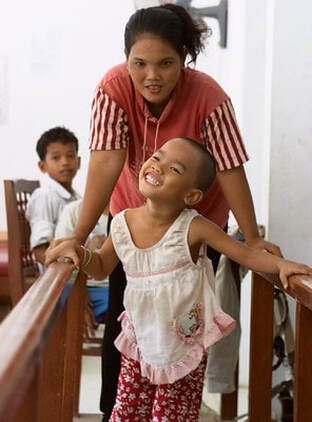 A girl of color with cerebral palsy walks. Photo: Exceed Worldwide, Flickr Creative Commons Darla Nagel is a biomedical copy editor who has an invisible chronic illness. She wants to educate healthcare professionals and encourage patients. If you want to receive quarterly updates from her, email darla.nagel{a}gmail.com.
|
Author:
|
 RSS Feed